
Making of a Painting VI: St. Maria Goretti
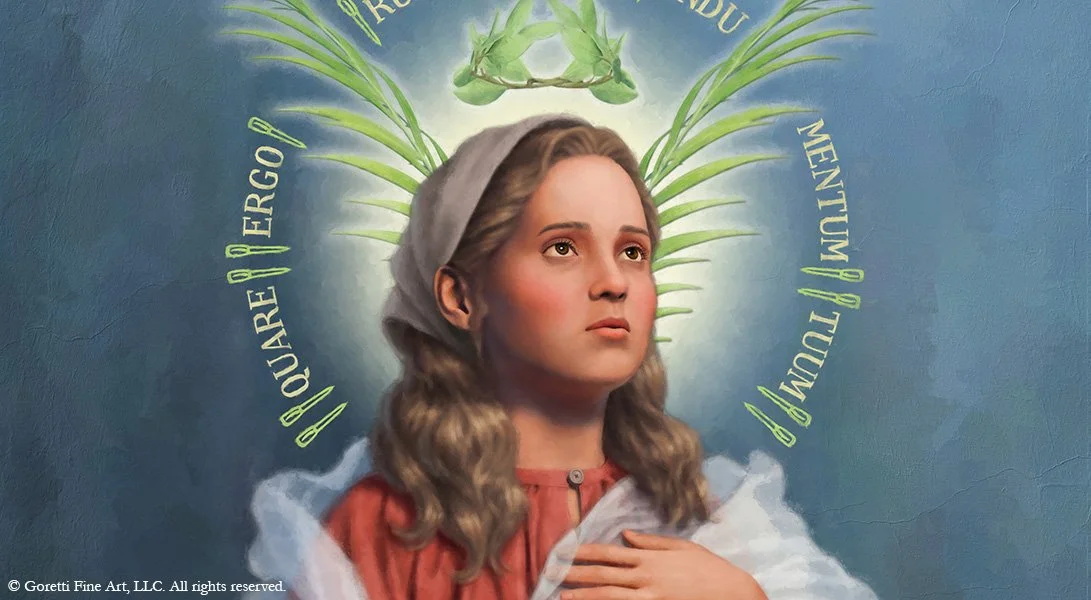
Introduction
I have written at length in a previous post about the challenges involved in depicting saints known from photographs. To capture the transfigured visage of one enjoying the Beatific Vision, a sacred artist must abstract from the particulars and imperfections of the individual’s earthly likeness. At the same time, a spiritual portrait must be recognizable, and the faithful rightly expect images of their saints to resemble any temporal portraits that exist.
For this reason, commissions that involve saints known from photographs must at least start with evidence of their physical appearance, even if the objective of the final painting is to transcend the physical. Sometimes the initial research is straightforward, as was the situation detailed in the post on Sts. Louis and Zélie Martin. Unfortunately, this is not always the case.
When it comes to saints, information available on-line and even in many print publications can be fraught with wishful thinking, as unsupported claims by credulous researchers are accepted uncritically and repeated endlessly until it becomes nearly impossible to track down and evaluate the original source. For this reason, careful sacred artists must approach their visual reference material with circumspection if they wish to avoid perpetuating errors. It happens that my two favorite saints, St. Charles Lwanga (my Confirmation patron) and St. Maria Goretti (the patroness of our studio), are cases in point.
A Cautionary Tale
My first experience with dubious photographic evidence of saints came some fifteen years ago when I received one of my first commissions: a portrait of St. Charles Lwanga (d. 1886). As I already had a devotion to the Martyrs of Uganda, I gladly accepted. I was aware of an alleged photograph of Lwanga and his companions that had recently surfaced and was circulating on the internet. Intrigued as to the basis for the identification, I dug deeper as part of my preparatory work for the painting.
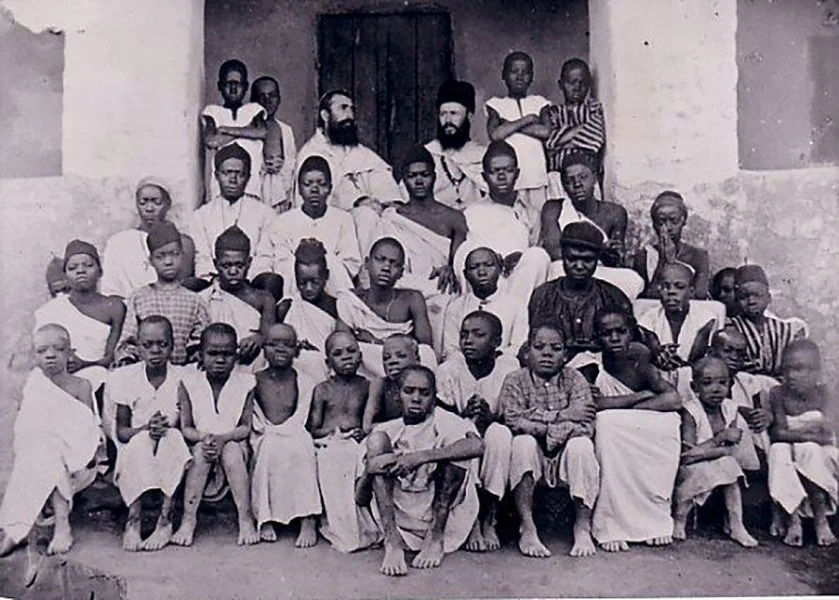
Despite frequent claims that it records the Martyrs of Uganda, this photograph probably depicts Tanzanian orphans.
To make a long story short, I eventually traced the claims to their origin in an obscure book published in Africa by a Ugandan religious brother named Tarcis Nsobya and found the rationale for the identification unpersuasive. On the contrary, my research suggested that the photograph more likely depicts the residents of an orphanage in Bukumbi, Tanzania, not the pages of the royal court of Buganda.
While disappointing from the perspective of my interest in the martyrs, the incident taught me to be wary of bold claims of photographic records of saints emerging long after the (generally quite exhaustive) biographical research conducted as part of the canonization process.
St. Maria Goretti – Background
It was with this in mind that I approached our latest commission: a portrait of St. Maria Goretti. In order to understand the context for the claimed photograph of Maria, it is important to know something of her story.
Maria Teresa Goretti was born into an Italian agricultural family in 1890. In 1899, poverty forced the Gorettis to move to Le Ferriere, an isolated backwater west of Rome, where her parents eked out a living as sharecroppers for a wealthy landowner, Attilio Gori Mazzoleni. The Gorettis shared simple lodgings with a widower named Giovanni Serenelli and his son Alessandro. The house was about a mile from Gori Mazzoleni’s estate, Casale di Conca, and seven miles from the nearest village of Nettuno.

The Gorettis and Serenellis shared lodgings on the second floor of this disused cheese factory in Le Ferriere. Image credit: Wikimedia Commons (CC 3.0).
The following year, Maria’s father Luigi died of malaria. To make ends meet, Maria’s siblings had to work the fields with their mother Assunta and the Serenellis, while nine-year-old Maria was entrusted with care of the household. In these conditions, she grew up quickly. Responsible, serious, and pious, she managed the household chores, mended clothes, cooked meals, took care of her baby sister Teresa, traveled to Conca to purchase necessities at the pantry, and prayed a daily rosary.
Alessandro Serenelli, meanwhile, was a troubled, antisocial young man with a traumatic past. After the death of Luigi, he and his father took advantage of the fact that they were the only grown men in the household. Giovanni acted possessively towards Assunta, and Alessandro took a fancy to Maria, who was physically mature for her age. He began making secret advances, which Maria always rebuffed.
Frustrated, resentful, and consumed with lust, the twenty-year-old Alessandro was determined to assert his dominance. On July 5, 1902, he took a sharpened iron awl, surprised Maria in the house in the middle of the day, and threatened to kill her if she did not submit to him. When Maria resisted, protesting that it was a sin, he flew into a testosterone-fueled rage and stabbed her fourteen times.
The crying of Teresa, the unattended two-year-old, eventually alerted the others that something was wrong, and Maria was discovered, still alive, in a pool of blood by the door. She was rushed to the hospital in Nettuno, where she was operated on without anesthesia. She lingered in excruciating pain for twenty-four hours, during which time she received Last Rites and expressed forgiveness for her killer, before expiring late in the afternoon of July 6.
Alessandro was sentenced to thirty years in prison. At first he was unrepentant, but in 1908 Maria appeared to him in a dream and handed him fourteen lilies. The vision changed the course of his life. Upon his release, he sought reconciliation with Assunta and lived out his final years as a lay brother in a Capuchin monastery. Both he and Assunta lived to see Maria declared a saint in 1950 in an unprecedented open-air ceremony attended by half a million people, including Assunta herself.
Enter Ugo De Angelis
As interest in Maria Goretti’s inspiring story grew in the decades following her canonization, claims were occasionally made that she had been identified in this or that old photograph. None of these allegations gained traction with scholars and students of Maria’s story, however, until about a decade ago a snapshot of Italian peasants feeding poultry began circulating on-line, and before long it had garnered wide acceptance as the only authenticated photographic likeness of the young saint.

Image credit: Wikimedia Commons (CC 4.0)
How and why this identification came about, however, was not readily apparent.
Of course I was intrigued to learn more, so I tracked the claim to a 2013 book published in Italy by an architectural historian named Ugo De Angelis. Entitled In Quella Foto C’è Maria (In That Photo Is Maria), it was not available in the U.S., but I eventually got my hands on a copy through a friend living in Europe.
In many ways, the book is an impressive contribution to Maria Goretti scholarship. De Angelis’s erudite explanation of the historical, socioeconomic, and environmental context in which her brief life played out is enlightening and his knowledge of the primary sources encyclopedic. In addition to contextualizing her story more rigorously than most popular hagiographies, he offers some genuinely fresh interpretations regarding the specifics of her biography. For example, he makes the case that Giovanni Serenelli was more than an innocent bystander in his son’s crime, and he leverages the autopsy report to contend that Alessandro tortured Maria with the murder weapon prior to giving up on the rape attempt and killing her. I found both arguments persuasive.
Unfortunately, the same cannot be said for the crux of the volume, a defense of his claim to have definitively identified Maria as the individual labeled Figure 4 in the photograph below.
Image credit: Wikimedia Commons (CC 4.0)
In That Photo Is Maria?
The image itself was not entirely unknown. It had originally been discovered in the family album of Attilio Gori Mazzoleni’s son Mario by a previous Goretti biographer, Fr. Fortunato Ciomei, in the 1960s. Ciomei had speculated that Figure 2 was Assunta and that Maria may have been one of the small children at her feet. This identification never gained much credence, however, and De Angelis correctly points out that Figure 2 does not resemble other known likenesses of Assunta. Instead, De Angelis argues that Figure 4 is Maria Goretti, pictured only a few months before her death. His reasoning as laid out in the book may be summarized as follows.
The photograph was taken in the courtyard of Casale di Conca, which Maria often visited to purchase salt and other necessities from the small general store.
The photograph was taken in or around February 1902. This conclusion is based on the following evidence:
a. The appearance of the vegetation suggests that the season is late winter.
b. Figure 5 appears to be Lorenzo Gori Mazzoleni, a son of Attilio born in 1890.
c. Figure 5 appears to be about twelve years old, which would date the photograph to 1902.
Figure 4 appears to be approximately eleven years old.
Maria Goretti was the only eleven-year-old female living in the vicinity of Conca in the late winter of 1902.
Figure 4 resembles photos of Teresa Goretti (who was said to look like Maria) as well as physical descriptions of Maria.
Based on this evidence, De Angelis purports to have found “the first and so far only existing photograph of the Martyr.”
Analysis of De Angelis’s Reasoning
Let us break down De Angelis’s claims step-by-step.
The photograph was taken in Conca. Judging from other turn-of-the-century photographs of the Gori Mazzoleni estate, this appears to be true. So far so good.
a. The season is winter. Again, this seems reasonable.
b. Figure 5 is Lorenzo Gori Mazzoleni. That Figure 5 is one of Attilio’s sons is at least plausible and perhaps probable, given the photo’s inclusion in the family album. Comparison to a photograph of Lorenzo and his brother Mario (b. 1892) taken in 1898 and published by De Angelis suggests a family resemblance, though Figure 5 (especially in the length of his mouth) seems to me to resemble Mario even more than Lorenzo. De Angelis presents testimony that Lorenzo visited Conca more often than Mario, but, given Figure 5’s features, coupled with the fact that the photograph wound up in the possession of Mario’s heirs, it is at least as likely that Figure 5 is Mario as Lorenzo. All told, the identification of Figure 5 as Lorenzo cannot be accepted with any certainty.
c. Figure 5 is twelve years old. Even if we knew for certain that Figure 5 was Lorenzo, his age in the photograph cannot be pinpointed with the precision which De Angelis claims and on which his argument depends. The most we could say for sure is that the photograph was taken sometime between the last few years of the 1890s and the first few years of the 1900s.
Figure 4 appears to be approximately eleven years old. Even if it could be proved that the photograph was taken in February 1902, it is far from clear that Figure 4 is eleven. She looks older to me. Granted, witnesses testified that due to an early puberty Maria appeared older than her eleven years, but Figure 4 could plausibly be anywhere from eleven or twelve to about twenty (indeed, we know that a twenty-one-year-old woman was living in Conca in 1902).
Maria Goretti was the only eleven-year-old female living near Conca in the late winter of 1902. Even if it could be proved that Figure 4 was eleven years old, it is simply not true that Maria Goretti was the only historically attested female of about that age living in the vicinity in 1902. Indeed, as De Angelis admits, Alessandro testified that the youngest daughter of a neighboring family, the Cerulinis, was about the same age as Maria. Now, Assunta stated that one of the Cerulini daughters made her First Communion at the same time as Maria despite being a few years older, and De Angelis assumes that this was the youngest daughter identified by Alessandro, thereby invalidating his testimony. But Assunta could as easily have been referring to one of the older daughters. In any case, given the impossibility of determining Figure 4’s age with any precision, Maria and the youngest Cerulini girl were apparently close enough in years that any difference between them would be within the margin of error involved in estimating the age of Figure 4.
Figure 4 resembles the Goretti sisters. It is true that Figure 4 bears a passing resemblance to portraits of Teresa Goretti when she was an older girl, but not much can be inferred from such a grainy, low-resolution photograph. In recent years, a few attempts have been made to “upscale” Figure 4’s face using digital technology—while the process involved is undeniably speculative, the version seen here is the most convincing one I’ve seen, and I think most people would agree that a Goretti family likeness is no longer readily apparent.
In summary, De Angelis’s reasoning does not withstand critical scrutiny. While the foregoing analysis leaves open the possibility that Figure 4 could be Maria Goretti, there is no good reason to think so, and certainly not with the degree of confidence evinced by De Angelis.
In That Photo Is NOT Maria
I believe we can go further, however, and state with something approaching certainty that Figure 4 is not Maria Goretti.
The first point to make is a general one. Given the tremendous publicity throughout Italy surrounding her beatification process, a time when so many who knew her were still alive, it is surprising that the photograph would not have surfaced earlier if it actually depicted the martyr.
Second, even by the standards of malnourished Italian peasantry, the Gorettis were short—extremely short. For an emphatic illustration of this, see the photograph of Maria’s sister Teresa with John Paul II (himself not an especially tall man) in 1979. Indeed, one of the most commonly remarked-on memories of Maria among the witnesses deposed during her cause was the contrast between her mature demeanor and her diminutive stature. In any case, we need not rely on qualitative descriptions, as her exact height at the time of death was recorded in her autopsy: 4 feet 6 inches.
Now, in comparing Figure 4 to the other individuals in the photograph, including the teenage boy at her side, the impression given is of a tall, robust young woman. This impression is strong enough to withstand any uncertain perspectival effects caused by vagaries in the lay of the land, etc. In addition, Alessandro testified that Maria habitually wore “long” (probably ankle-length) clothing, whereas the skirt worn by Figure 4 appears to reach only to mid-calf.
De Angelis recognized these difficulties but explained them away by positing that Figure 4 is standing on an upturned bucket obscured from view by the fowl and is thus much shorter (and her dress much longer) than it appears. In other words, although the eye’s most natural interpretation of the photograph is that Figure 4 is standing at the elevation level marked 1 (blue) in the image below...
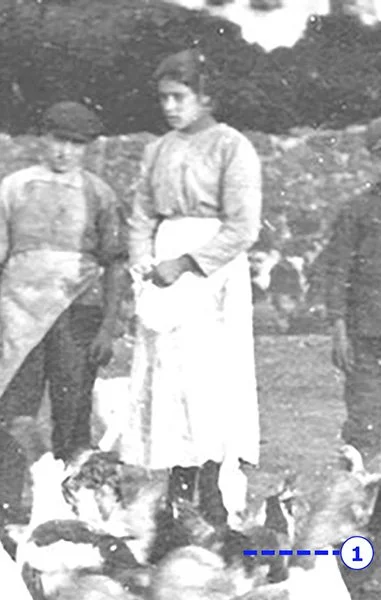
Image credit: Wikimedia Commons (CC 4.0)
...De Angelis would have us believe that an invisible bucket provides a platform that brings her feet to around the elevation level marked 2 (red).
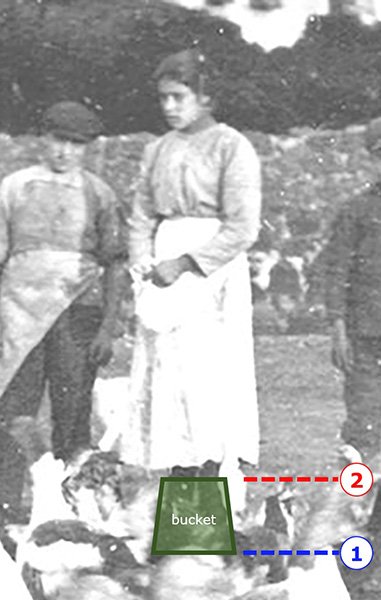
Image credit: Wikimedia Commons (CC 4.0)
Unfortunately, this interpretation, while clever, is not tenable. In addition to violating Occam’s Razor, it is at odds with the proportionality of those parts of Figure 4’s body that are clearly articulated. We artists know the rule of thumb that women’s height from puberty through adulthood averages between 7 and 7.5 times the height of the head. My analysis below shows that Figure 4 falls squarely within this range, with limbs well-proportioned for a teenage female, if she is standing at Elevation 1...
Image credit (left): Wikimedia Commons (CC 4.0)
...whereas head-to-body-height ratio would more like that of a typical six-year-old—and her arms impossibly long—if she were standing at Elevation 2.
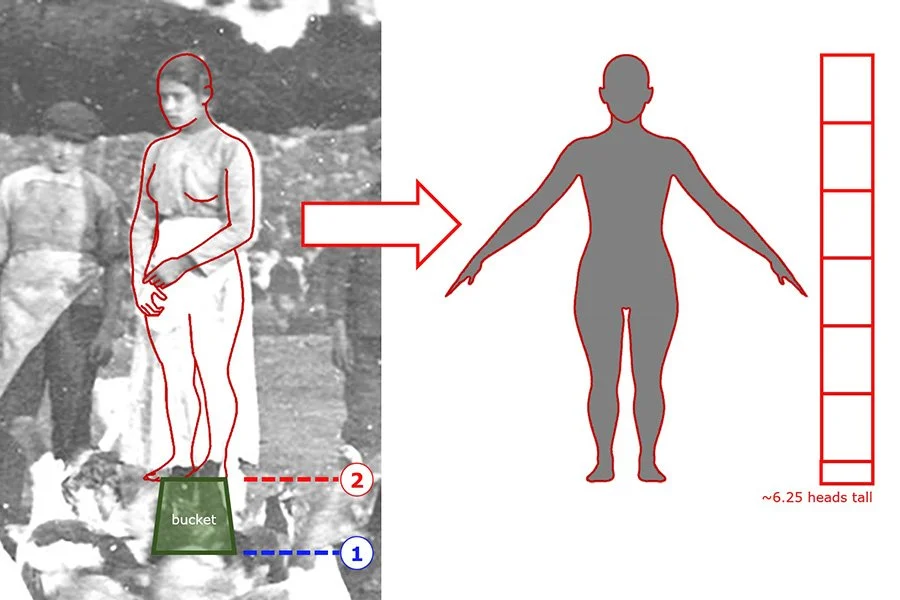
Image credit (left): Wikimedia Commons (CC 4.0)
Lest one think that the Gorettis were congenitally ape-like in their proportions, photographs of Maria’s sisters Teresa (left) and Ersilia (right) at ages similar to that of Maria in 1902 show perfectly normal ratios, and there is no reason to think that Maria was any different.
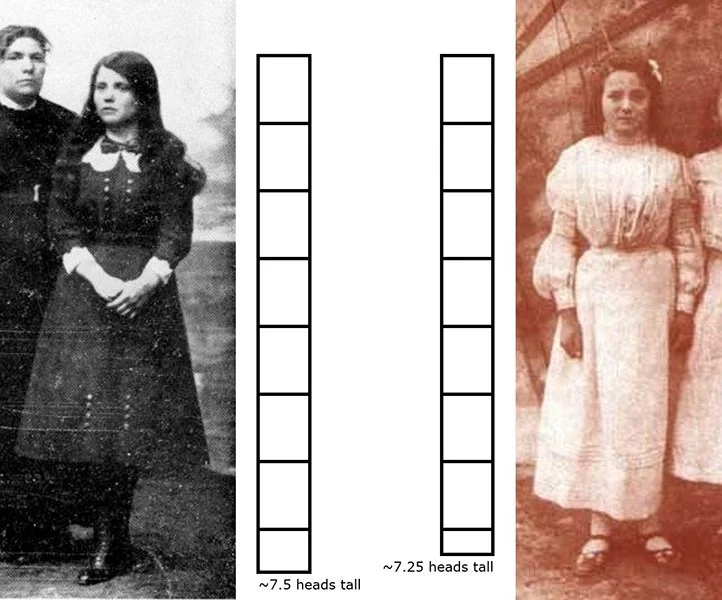
These photographs of Teresa (b. 1900, left) and Ersilia Goretti (b. 1898, right) were each taken when the girls were close to the age Maria was in 1902.
In conclusion, there is no invisible bucket, and Figure 4 is almost certainly not Maria Goretti.
In Pursuit of a Likeness
This does not mean that we have no idea what Maria Goretti looked like, nor was I, as an artist, “off the hook” with regards to capturing Maria’s authentic physical likeness in our spiritual portrait. We have well-attested photographs of Maria’s father, mother, and siblings, which show clear family traits that Maria no doubt shared. She was said to bear an especially close resemblance to her sister Teresa, who is known from multiple photographs taken around the age Maria was when she died.
Meanwhile, eyewitness testimony informs us that Maria had wavy blonde hair, brown eyes, a fair complexion, a slender build, and a face that was structurally round but lean, owing to the family’s limited diet at the time of her death. The reports associated with the autopsy even afford specifics on such details as her eyelashes (thick) and eyebrows (thin).
Finally, in 1929 the artist Giuseppe Brovelli-Soffredini collaborated with Assunta on a portrait of her daughter, based on physical descriptions and a photograph of Teresa. Assunta provided corrections (an early draft was too plump!) and approved the final painting as an authentic likeness.
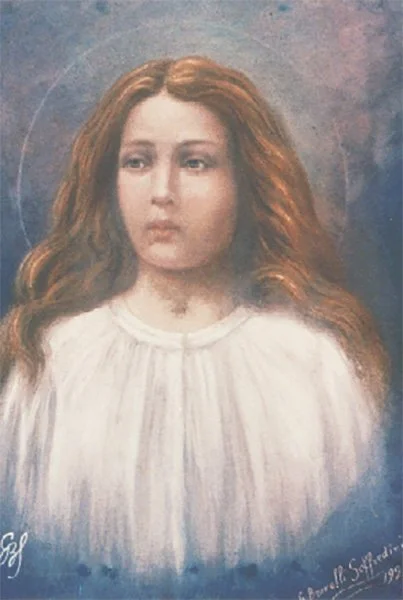
Brovelli-Soffredini’s 1929 painting
As Maria’s hagiography developed, numerous pious portraits were produced, but Assunta always maintained that the Brovelli-Soffredini painting most closely resembled her daughter.
Thus, I had ample material from which to construct a likeness and triangulated among all these written and visual sources in producing our studio’s contribution to Maria’s growing iconographic corpus. As usual, I started with pencil studies…
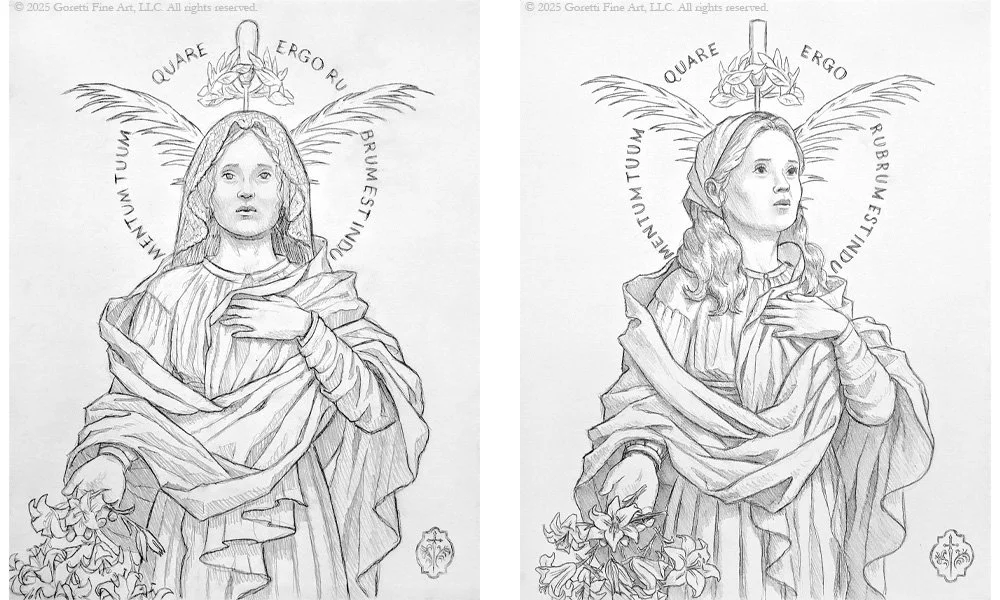
I explored different conceptual approaches in these early graphite sketches. The awl-shaped object in the halo represents the instrument of martyrdom (and became a more stylized design element as the composition developed).
…before proceeding to add color, a process that was influenced by the portrait’s status as a companion piece to a depiction of St. Patrick that we were working on at the same time.
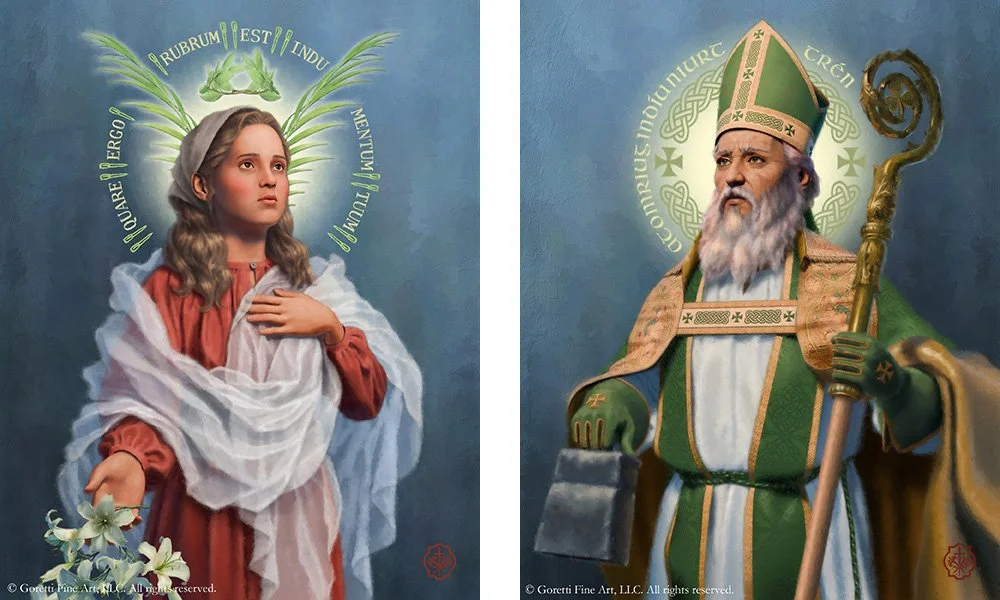
Our portrait of St. Maria Goretti (left), along with the portrayal of St. Patrick with which it was commissioned as a pair
Our hope is that the resulting painting faithfully captures Maria’s earthly appearance while at the same time elevating it to a supernatural plane that reflects her Heavenly glorification, as well as the timeless ideals she has come to represent.
Conclusion
The process of producing this portrait of Maria Goretti was a powerful and deeply moving experience, given my personal devotion and the connection with our studio. We are grateful to the client for the opportunity to immerse ourselves in the source material related to her life and, most importantly, to pay artistic tribute to this little saint whose courage continues to inspire successive generations to lives of Christian virtue.
Further Reading
De Angelis, Ugo. In Quella Foto C’è Maria: Una Storia di Virtù, Crudeltà e Pentimento. 2nd ed. Italy: Nane Edizioni, 2014.
Poage, Godfrey. St. Maria Goretti: In Garments All Red. Rev. ed. Charlotte: TAN Books, 2015.